
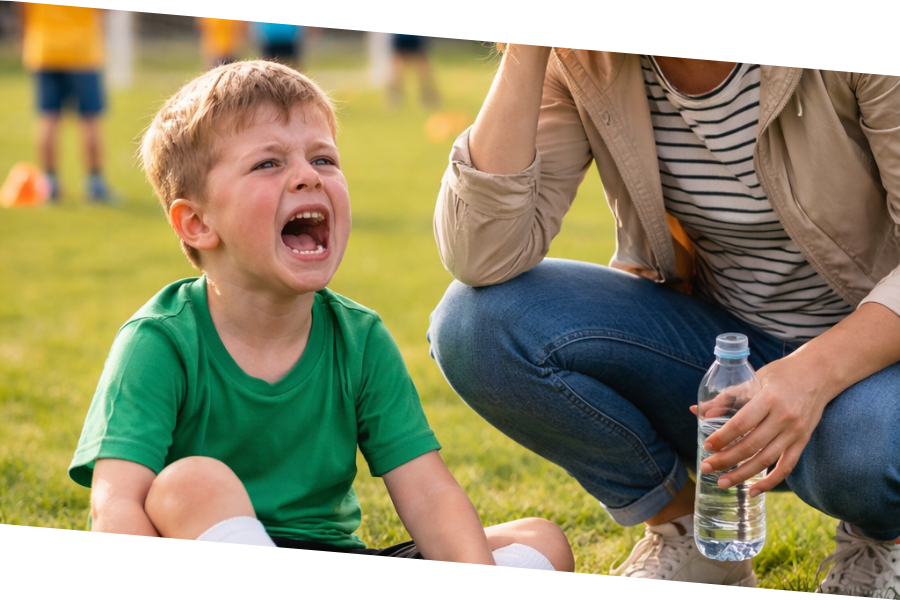
Have you ever wished you could understand the ‘why’ behind your child’s behaviour, so you can put an end to power battles and start seeing more cooperation, greater independence, and stronger family relationships?
If you have, you are not alone.
At Sportivos, I have spent years learning how behaviour really works, because great coaching is not just drills. The biggest battles are rarely about football. They are about emotions, connection, confidence, and control.
We run Sportivos sessions for children aged 2 years + in central Scotland and North West England with classes being held in Dunblane, Stirling, Bridge of Allan, Callander, Auchterarder, Kendal, Ambleside, Carnforth, Lancaster, and Morecambe. In every location, and across every age group, the same patterns show up. The behaviours look different depending on age, but the needs underneath are usually the same.
If your child clings, refuses, whines, or melts down when a football class starts, it is rarely about football. It is usually about two emotional needs, belonging, meaning do I feel safe and connected, and significance, meaning do I have some positive power and capability.
In this blog you will learn what your child is communicating, and one simple pitch side tool you can use straight away.
A child arrives happy, kicking a ball, chatting, and laughing. Then the session begins, and suddenly they are on the ground, glued to mum or dad, upset about a drink, arguing about a bib, or refusing to join in.
These behaviours are rarely random.
A simple idea from Adlerian psychology helps a lot. All behaviour is goal oriented. Children use trial and error, and if a behaviour works, it returns.
The start of session moment is tricky because it is a transition from free play to structure, a social shift where others are watching, and a challenge where they might get something wrong. If your child’s behaviour changes at that exact moment, it is information, not a mystery.
A useful way to frame it is this.
Once a child’s basic needs are met, most behaviour links back to two emotional needs.
In our 18 months to 3 years sessions, belonging behaviours are obvious. Clinginess, shyness, hiding behind a parent, and toddler tantrums are common. Parents often say, my child is shy, but what we are often seeing is a child checking safety and connection.
In our 5 to 8 sessions, belonging can look like hanging back, being silly to get a laugh, talking over the coach, copying others, or blaming someone else so they do not feel exposed.
Even in advanced one to one sessions with children aged 8 to 14, belonging can show up as fear of judgement. A player can be keen and talented, then the moment it gets hard they go quiet, joke, or switch off. Underneath is often, ‘do you still rate me if I struggle?’
Significance is the need to feel capable and in control. If children do not get enough positive power, they often grab negative power.
That can look like refusal, ignoring, doing the opposite, shouting, or turning everything into a debate. If you plead, bargain, or threaten, the power battle usually grows because the child is now controlling the room.
In older children, significance can hide behind attitude. Eye rolling, laughing things off, arguing, or acting like it is boring can be a way of staying in control when they feel challenged.
This is not because your child is bad. It is because they are trying to meet a need.
A misbehaving child is a discouraged child.
Discouraged does not mean sad. It means the child does not feel enough belonging and significance, and they do not know how to get it in a positive way.
So underneath the behaviour is often this message.
I want to belong. I want to feel significant. I just do not know how.
When behaviour flares up, pause and ask yourself:
A little girl attending one of our classes, arrives happy most weeks. During school holidays her behaviour shifts. Routines are different, siblings are around more, and family energy is higher. We noticed she was a middle child, when the session starts she becomes silly, interrupts, and pulls mum into constant negotiation.
If mum responds with lots of attention, the behaviour grows, because it worked and it gave connection. If mum then switches to strict commands, the child can flip into refusal, which becomes a power moment.
We see the same pattern in our toddler sessions during school holidays, when school is out and siblings tagging along. The youngest often clings first, the eldest often worries about doing it right, and the middle often seeks attention through humour. Different ages, different strategies, same needs underneath.
Birth order is not destiny, but it can explain patterns, especially in groups.
If this rings true for your family, it gives you a clue about what your child is protecting when they kick off.
One breath. Fewer words, softer voice, slower movement.
Is this belonging, or significance?
Belonging means they need connection. Significance means they need positive power.
I can see you are having a hard moment. I am here. And we are still doing this.
Then give one small choice:
Then hold the boundary kindly. No debate, no long speech, calm leadership. You can do the teaching later, when everyone is calm again.
Fewer repeated instructions, shorter tantrums, quicker recovery, smoother transitions, more willingness to try again.
Bonus habit: give two minutes of focused attention each day when they are calm. Those small belonging deposits prevent bigger explosions later.
No. Toddlers show it loudly. Older children often show the same needs through joking, arguing, blaming, shutting down, or refusing to try when challenged.
Usually a belonging signal. Give a quick connection, offer one small choice, then hold a calm boundary.
Refusal is often significance and power, or protection from feeling judged. Avoid pleading. Use the Pause and Decode Reset, then give one choice and a kind boundary, and let the coach take the lead.
It can work short term, but it can teach,’ I only cooperate when rewarded’. Connection plus choice builds longer term cooperation.
Come and give Sportivos a try.
Our classes are about more than football. We build confidence, connection, and calm, so children feel safe to have a go, brave enough to try again, and proud of themselves when they do.
And the funny thing is, when you get those foundations right, being really good at football becomes the by-product. That progress reinforces confidence and self belief, and it is what makes everything we do worthwhile.
We coach children from 18 months to 8 years in our group classes, we run advanced one to one sessions for children aged 8 to 14, and we offer Sportivos birthday parties too.
Yes, we run school programmes. Teachers often compliment our calm, consistent class management, and it comes from understanding what the behaviour is communicating, then responding in a way that meets belonging and significance while still holding clear boundaries.
All enquiries, please email hello@sportivos.co.uk